
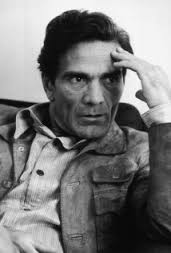
Four decades ago, on the morning of 2 November 1975, in a shanty town outside Rome, a woman noticed something in front of her house. “See how those bastards come and dump their rubbish here”, she reportedly complained. What she had seen was not in fact rubbish, but the body of the writer and film-maker Pier Paolo Pasolini, beaten beyond recognition and run over by his own Alfa Romeo.

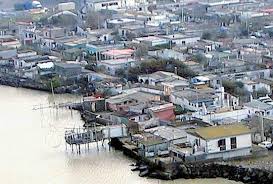
The scene of the murder, Idroscalo, recalls a setting for a Pasolini film or poem or novel: shacks lie scattered across a filthy, blackened beach and in the distance rise the tenement slums of Nuova Ostia near Fiumicino airport.

A 17-year-old rent boy named Giuseppe Pelosi later confessed to the murder. Was this a homosexual assignation gone fatally wrong, or was Pasolini the victim of a political assassination? His presumed killer was found to have contacts with the Italian neo-fascist party, the Movimento Sociale Italiano; the verdict is still open. Pasolini was 53.
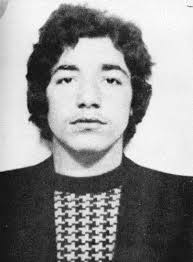
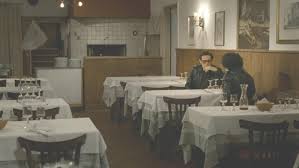
What really happened that night at Idroscalo? Pelosi – known to his friends as “Pino la Rana” (Joey the Toad) – hustled on the streets of Rome round Termini Station. Pasolini picked him up there in his Alfa Romeo, then drove with him to Ostia ostensibly for sex, after buying him a plate of spaghetti at a roadside trattoria overlooking the River Tiber.
Though physically robust, Pelosi alone surely could not have inflicted such violence. No trace of Pasolini’s blood was found on his clothes or person at the moment of his arrest twelve hours or so later. Today, having served a nine-year prison sentence, Pelosi claims that at least three other aggressors were present at Idroscalo. Who exactly they were remains a mystery even to Pelosi; they had “strong Sicilian accents”, he recalled, and may have been known to Pasolini himself, who had used the Sicilian city of Catania and the volcanic slopes of Mount Etna nearby as film locations. According to Pelosi, one of the assailants uttered the Catanian dialect word “jarrusu” (faggot) as he bludgeoned the director to death.

Though Pasolini was born in Bologna (in 1922), Rome was the place where the writer in him was born. Indeed, Rome provided Pasolini with material for the 1955 novel that made him famous, Ragazzi di vita (translated into English as The Ragazzi, more literally as “The Boys of Life”). Made up of a series of fast-moving cinematic vignettes from the Roman underworld, the novel recounts the adventures of a gang of youths who subsist on the city outskirts by thieving and pimping, Pelosi-style.

Pasolini’s solidarity with sub-proletarian Rome was at heart romantic. La ricotta, his 35-minute episode in the collaborative film RoGoPaG (1963), features Orson Welles as an American director shooting a film on the Rome outskirts about Christ’s Passion.
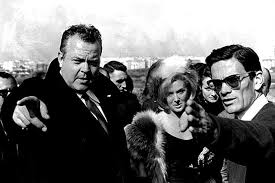
“Stracci’ (Rags), the actor who plays the part of the ‘good thief’ perishes on set from a case of real-life starvation. (He eats so much ricotta curd cheese during a break from filming that he dies while up on to the cross under a broiling Roman sun.) For all its manifest compassion, the film led to a suspended prison sentence for Pasolini on blasphemy charges. One can see why. Over a tableau vivant inspired by Baroque paintings of the Deposition by Pontormo and Giovanni Battista di Jacopbo, Welles cries out (in Italian): “Get those crucified bastards out of here!”, “Bring up the crosses!”, “Leave them nailed up there!”