
Among contemporary British novelists influenced by Calvino are David Mitchell, Tom McCarthy and Ali Smith. Salman Rushdie owes the most significant debt. His new novel, Two Years Eight Months and Twenty-Eight Nights, references Our Ancestors countless times, and shares something of the trilogy’s wickedly effective pastiche and sly philosophic humour. However, Calvino was not the avant-garde experimentalist that Rushdie and others have claimed him to be.

Calvino’s first novel, The Path to the Nest of Spiders (1947), written at the age of only 24, was born directly out of his experience as a partisan during Italy’s anti-Fascist Resistance. Ostensibly it was influenced by Ernest Hemingway (who served as an antidote to Fascist-era rhetoric and obfuscation) and Italy’s “news-reel” school of cinematic realism, which aimed for an unpolished immediacy off the streets.
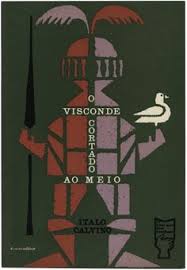
However, by the time Calvino published his next novel, The Cloven Viscount (1952), it seemed he had transformed overnight into a dazzling fabulist. (“Shazam!”, Rushdie wrote of the apparent metamorphosis. “Politically-committed Calvino into Captain Italo Marvel!”) The Viscount hero of the title is cut in two by a cannon ball somewhere in medieval Bohemia. The one half is good; the other, which delights in collective hangings, is not. In the end, they fight a duel, after which they are sewn back together by a Dr Trelawney, who is lifted from one of Calvino’s favourite authors, Robert Louis Stevenson. Was it possible that Calvino was himself bisected into two, seemingly unrelated sides: a “realist Calvino” and a “fabulist Calvino”?
In reality, the Calvinian halves were one and the same. Already in his debut novel the writing was marked by a fabulous gothic undertow, with allusions to medieval artists such as Hieronymus Bosch and Albrecht Altdofer. The Piedmontese novelist and poet Cesare Pavese was among the first to detect the fable-maker in Calvino. Calvino was a “squirrel with a quill”, Pavese declared, whose first book read like a “folk tale from the forests”.

Before all else, Calvino was a story-teller, and at heart a moralist. Even as he wrote his fantastical sequel The Baron in the Trees (1957), about a child aristocrat who flees to the treetops in protest against his parents, Calvino was at work on short stories about the “emptiness of consumerism” in post-Mussolini industrial Italy. These were later collected in the volume Marcovaldo (1963) and showed how deeply Calvino’s fiction is rooted in the familiar. Even the lush vegetable kingdom in The Baron in the Trees reflects the varied arboreal life of Calvino’s native Liguria in northern Italy, where his botanist father ran a tropical floricultural station.

If Calvino had been concerned merely with cerebral manipulations of narrative patterns, his appeal would not have been so broad. Beneath the mandarin, almost etiolated prose of his magnificent Marco Polo fantasia, Invisible Cities (1972), was a writer who had been a member of the Italian Communist Party – until 1957, when he resigned in disgust after Soviet tanks had crushed the Hungarian uprising in Budapest.

I must say Calvino’s death moved me personally. In 1983, two years before the fatal haemorrhage, I wrote to Calvino requesting an interview in Rome. To my delight, he agreed. In his flat near the Pantheon he leafed through the many pages of questions I presented. “Troppo, troppo, too many”, he said. (I was then a callow 22-year-old.)
After three hours, Calvino’s Argentinian wife Esther ‘Chichita’ Singer gestured me to the French windows. “Mr Thomson, do look at our garden.” There were hundreds of bougainvilleas – a wash of pink in the Roman evening. Years later, when I called on Esther to research my biography of Calvino’s friend Primo Levi she said she remembered that evening all right. “But I think it would only be fair now, ten years on, to tell you that I invited you to look at the flowers to mean that the interview was over.” She added: “Not for one moment did I think you were interested in flowers.” (Calvino, with his botanist background, was proud to know his bougainvilleas from other flora.)