

Nothing came of the Palio documentary, but Huxley was keen to co-operate. His mysticism had flourished amid the brash materialism of Hollywood. His wife Maria was dying of cancer. “Yet she was completely at ease with the thought of death and said it would be like going from one room to another”, said Laura. Maria died in February 1955. “Aldous was terribly, terribly distraught, and so alone.” Laura was interested in the neurological basis of hallucinations and guided Huxley on a mescalin trip in October 1955. “I hoped he might speak to me about Maria.” Huxley took a 400-milligram capsule and before long the room was a shimmering mass of pointillist particles. “Oh if you could only see your hair”, Huxley marvelled as Bach’s Fourth Brandenburg Concerto played on the turntable. “I was worried about the new rinse I had put in the day before”, Laura laughed. Presently the record came to an end and Laura walked quietly towards the phonograph. “With my first step I suddenly felt the presence of Maria. I mean she was present in me.” Laura was two paces from the turntable when Huxley’s voice reached her. “Don’t ever be anyone but yourself.”
Laura knew that she would never be able to look after Huxley in the way Maria had done; they had been married for 35 years. Laura recalled with horror the evening Huxley strayed out unaccompanied and fell down a ravine near their Hollywood house, headlong into dust and cacti. “Not surprisingly I got cold feet at our wedding”, Laura told me. “I told Aldous there were others I loved. He replied: ‘It would be awful if you didn’t, my dear.”

On impulse, they decided to get married at a drive-in chapel in the Arizona desert. It was a late Sunday afternoon in March 1956. “Do you think it might be amusing to get an instant marriage?” Huxley had asked. Laura, 20 years his junior, was delighted. “I have an anti-ritualistic streak. and it seemed quite natural – even if the ladies’ room attendant had to act as my witness!”
Drive-in weddings were then a fairly common way of tying the knot in the film community; Anita Loos mentions it in her Hollywood satire, A Mouse is Born. Loos, better known as the author of Gentlemen Prefer Blondes (one of the funniest novels ever written, in my opinion), had been a close friend of Huxley. She offered the newlyweds her New York apartment and gave them tickets for the Broadway premiere of My Fair Lady.

It turned out to be a contented enough marriage.
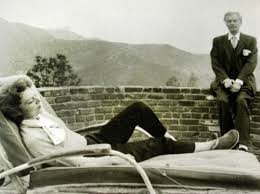
But disaster struck one day in May 1961 when a domestic fire broke out at their house on Deronda Drive. Laura widened her eyes at the memory. “The wild crazy grace of the flames!… I just stood there in a trance, watching this great rosy glow.” Aldous managed to salvage the manuscript of his last novel, the proto-hippie Island; and Laura escaped with her 1705 Cremona violin, a childhood gift from her father. But letters from Bertrand Russell and an entire correspondence between Hemingway and Virginia Pfeiffer, together with recordings of Laura’s violin debut at Carnegie Hall, were devoured in the flames. Huxley’s whole past had gone up in flames. if there are so few decent biographies of Huxley (apart from Sybille Bedford’s two-volume classic), it is partly because the essential documents were burned to a cinder.
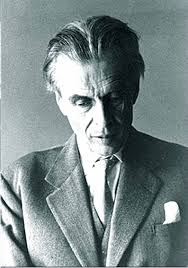
On the day Aldous Huxley died of cancer 22 November 1963 he asked for a dose of LSD to speed him on his way and Laura obliged. (‘Light and free you let go, darling. And you are going toward the light…’) President John F. Kennedy had been assassinated in Dallas earlier that afternoon; ignorant of the event, Huxley asked for the drug to be administered in extremis. (“Try LSD 100mm intramuscular”, he scrawled on a piece of paper.) Laura remembered the beginning of a smile. “Then all was quickly silent, and I knew he had landed on the other shore.”