

“Oh, some of my films have been attacked with absolute vitriol!” said Nicolas Roeg, now in his late eighties, but still one of the darkest and most innovative of post-war British directors. We were sitting in his study in Notting Hill in west London; nearby in Powis Square is the house Roeg used for his 1968 debut, Performance, starring Mick Jagger as the rock star who entices a gangster (James Fox) into a drug-induced identity crisis. The film was shelved for a year before Warner Brothers dared to release it.
“The critics didn’t always get it then – but they do seem to now”, said Roeg.
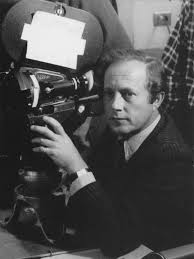
Roeg was born in 1928 in St John’s Wood into a vaguely bohemian background. A lifetime’s accumulation of books, awards and framed pictures of his former actress wife Theresa Russell spills into the room. Roeg, a rumpled, softly-spoken man with a very English reserve, recently published a book of reflections on film, The World is Ever Changing, in which he chronicles (among other things) his “flawed life” as a director.
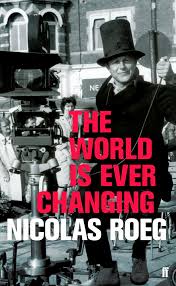
“I liked the book a lot”, I said.
“It’s very nice of you to say so. The last thing I wanted was to write an academic treatise or to lecture at the reader from the pulpit.” Instead the book is tinged with a sense of amazement and the self-examination of an older man looking back on a most unusual career.
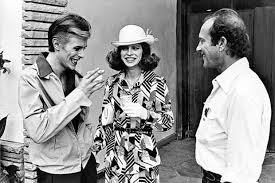
Roeg was eight when he discovered film. “Going to the cinema was an adventure. I was always a bit arty-farty as a boy. ‘Come on, Mr Arty-Farty’, my sister used to say to me.” Babes in Toyland, with Laurel and Hardy, was the first movie to open up the “mystery” to Roeg of celluloid make-believe. Roeg’s has always been a painterly imagination. In his immensely stylish The Man Who Fell to Earth (1976), starring David Bowie as an extra-terrestrial in search of water for his drought-stricken planet, Roeg made an artist’s use of the parched hinterlands round New Mexico. The film, based on the fine, 1963 novel by Walter Tevis, has worn well; Bowie’s death lends it a haunted, valedictory quality.

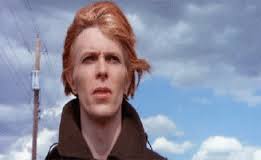
Bowie was reportedly on cocaine for much of the shooting. “Well, David’s performance was something quite unique. He never came on like a rock star – he used his part to explore ideas of rock idolatry and celebrity. David was very clever and creative in that way.” Roeg had originally wanted Peter O’Toole to play the part of the alien, but changed his mind after seeing the 1975 BBC documentary, ‘Cracked Actor’, which depicts Bowie on tour in Los Angeles, looking gaunt and otherworldly.

 Bowie’s 1977 album Low was intended partly as a soundtrack to the film, but Roeg chose not to use it. “It was better that way – the film was able to keep its integrity.”

Impressively, Roeg’s career spans half a century from his start as a clapperboy for MGM in 1950 and camera operator for such unlikely films as Tarzan’s Greatest Adventure. “I came up the old-fashioned way – tea-boy, cutter, focus-puller, cinematographer – but I wasn’t myself old-fashioned.” In the early 1960s Roeg worked for David Lean on Lawrence of Arabia and Dr Zhivago and, later, for Francois Truffaut.

Roeg’s best-known film, Don’t Look Now (1973), was a meditation on supernatural coincidence set in Venice, that still frightens like an unlucky number. With its use of swift cross-cutting and tumultuous imagery, the film radiates a fierce beauty and disquiet that could only be Roeg’s.